A penny saved is a penny earned. It’s an age-old saying, but it remains as true as ever. Saving money can bring the same value to your sole trader business as earning it. Who doesn’t like to save money where possible?
However, tax is seldom top of the list when sole traders consider where they could save money. So, how could your sole trader business possibly save on tax?
1. Claim all of your allowable expenses
If you’re not claiming for all of your allowable expenses, you’re paying more tax than necessary. It’s that simple. Allowable expenses are business running costs that HMRC allows you to claim back. To be an allowable expense, a service or product must be bought “wholly and exclusively for the purposes of the trade, profession or vocation”. If you use something for business and personal reasons (eg a mobile phone), you can only claim for the business-use proportion of the cost (eg 60%). Find out the full list of things you can claim as an allowable expense and make sure you’re doing so. It could make a big difference to your yearly tax bill.
Need to know! If you did not claim an allowable expense in a previous tax return, you have 12 months from the filing deadline to amend it.
2. Set up a home office
Most if not all business owners have admin tasks to complete, whether related to tax, marketing, sales, legal compliance, etc. You may already be completing many such tasks in your home, without claiming for home office expenses. You can set up a basic office in your home, perhaps in a spare room, and claim a proportion of your domestic bills to cover your costs. You claim for home office allowable expenses by summarising them within supplementary page SA103, which you file with your main SA100 Self Assessment tax return. You don’t need to submit proof of your allowable expenses when filing your tax return, however, HMRC can ask for it later.
3. Increase your pension contributions
As a self-employed person, you need to set up a private pension if you want to supplement your State Pension when you retire. This is advised. Once you start paying into a private pension, you can claim tax relief on your pension contributions. Basically, you pay tax on your earnings before you make a contribution, but your pension provider claims back at the basic rate of 20%. So, for every £80 you pay into your pension, £100 will go into your pension pot. If you’re paying the 40% higher rate of Income Tax, you’ll get additional tax relief (tax rates and relief are slightly different in Scotland).
Did you know? ISAs (Individual Savings Accounts) allow you to save up to £20,000 a year tax-free (2025/26 tax year). There are four types of ISA – cash ISA, stocks and shares ISA, innovative finance ISA and Lifetime ISA.
4. Claim Marriage Allowance
About 2.3m people in the UK claim Marriage Allowance. It saves them £252 a year in Income Tax. Basically, it allows a low-earner to transfer £1,260 (10%) of their Personal Allowance to their higher-earning husband, wife or civil partner, thereby reducing their Income Tax by £252 a year. For Marriage Allowance to be worth transferring, the lower-earner’s total income must be below the Personal Allowance threshold (ie £12,570), while the higher-earner must earn between £12,571 and £50,270 (£12,571-£43,662 in Scotland).
5. Employ your spouse
Sole traders can employ others. Many spouses or partners take care of business admin for their sole trader spouse or partner. Often, they do this for free, but you can pay your spouse or partner to work for your sole trader business, and this can mean you pay less tax, because it increases your costs and decreases your taxable profits. Their work must be ‘wholly and exclusively’ for your business and their wages must be fair and proportionate for the work they do. You cannot pay unjustifiably high wages; they should receive the same amount that you would pay someone else for the work. If their total earnings are below the standard Personal Allowance (£12,570), they won’t pay Income Tax.
Need to know! You must pay spouses, partners and family members in the same way as any other employee, via payroll, making any necessary tax deductions, while paying employer’s NICs where applicable.
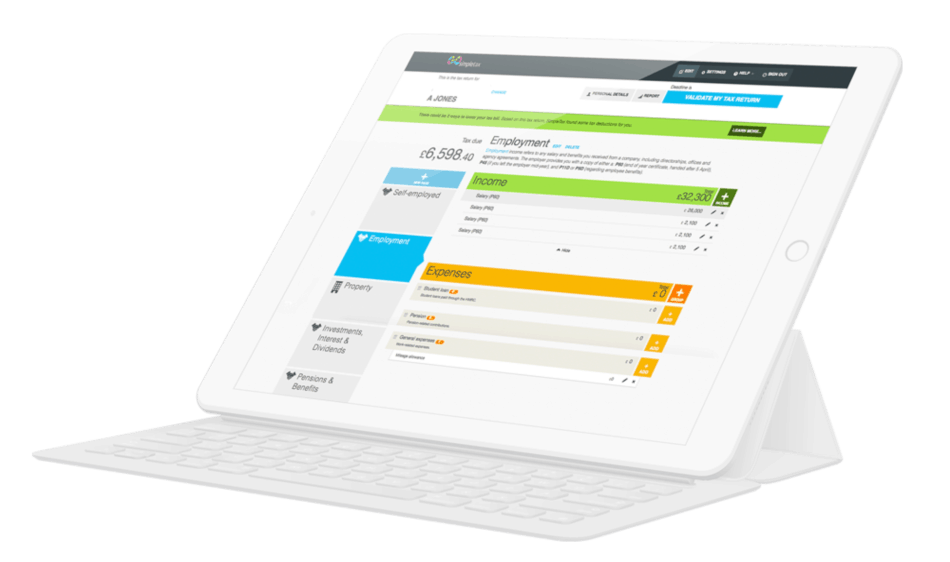
If you currently use an accountant, another way to reduce your tax-related costs is to start completing and filing your own tax returns. GoSimpleTax is award-winning software that offers you an easier way to complete and file your Self Assessment tax return. And to ensure that you’re claiming all of your allowable expenses, why not get your Self Assessment tax return checked by one of our experts? Start your FREE trial today!
Blog content is for information purposes and over time may become outdated, although we do strive to keep it current. It's written to help you understand your Tax's and is not to be relied upon as professional accounting, tax and legal advice due to differences in everyone's circumstances. For additional help please contact our support team or HMRC.

5 Excellent Reasons to Choose Us to File Your Tax Return
Discover how to make tax returns a doddle...
Find out moreSelf Assessment and MTD Tax Returns: What £50K Earners Need to Know
02 Jun 2026
What happens after I file my Self Assessment tax return?
11 May 2026
What’s Changing Under the UK’s New Foreign Income Rules in 2026?
08 Apr 2026